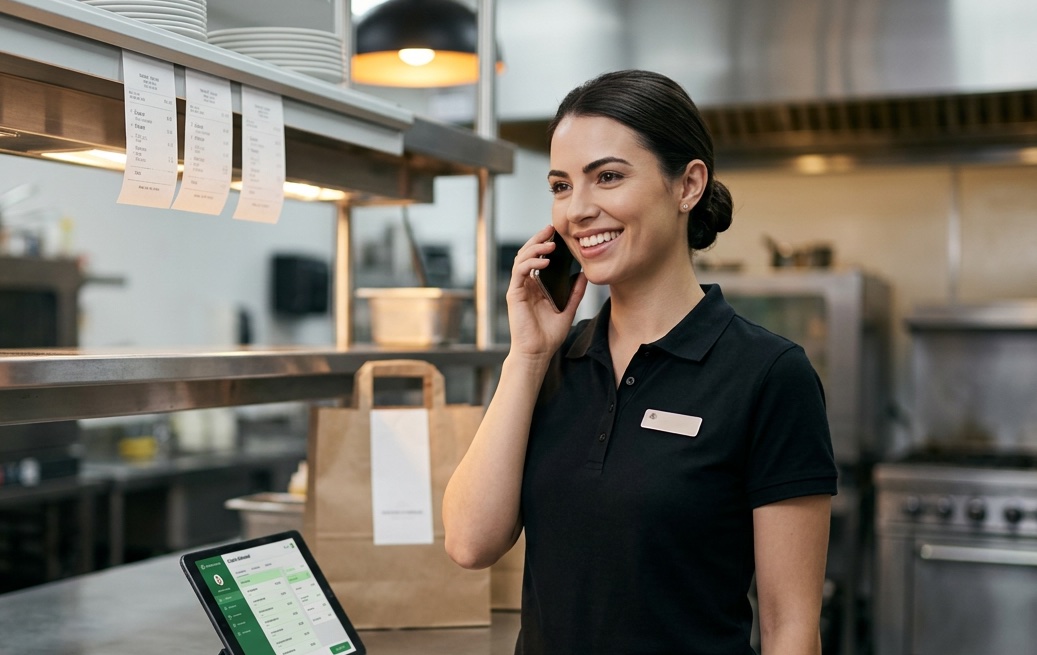
Most of the conversation about restaurant phone systems assumes a dining room exists — a host stand, a hostess, a guest walking in the door. None of that applies to a cloud kitchen. There's no front-of-house at all. Which raises a real question: if a delivery-only kitchen has no host to replace, does an AI phone agent even make sense for it?
The answer is yes — but for a different reason than it does for a dine-in restaurant. For a cloud kitchen, the phone isn't about hospitality. It's about margin.
Quick definition, if you're new to the term
A cloud kitchen (also called a ghost kitchen, dark kitchen, or virtual kitchen) is a commercial cooking facility built exclusively for delivery and takeout — no dining room, no walk-in counter, sometimes running several different "restaurant" brands out of one physical space. Customers never see the kitchen; they only see the brand on a delivery app or a phone number.
The real cost center isn't missed calls — it's commission
For a dine-in restaurant, the phone problem is about answering fast enough. For a cloud kitchen, the bigger problem usually isn't speed — it's where the order is coming from in the first place. Most cloud kitchens route the large majority of their volume through third-party delivery platforms, and those platforms charge a meaningful commission on every single order, commonly in the 15-30% range depending on the platform and market.
Without a dining room to offset that with full-margin, walk-in revenue, a cloud kitchen feels every one of those percentage points directly on the bottom line. A $50,000-revenue month running mostly through delivery apps can mean somewhere in the range of $7,500-$15,000 paid out in platform fees before anything else — rent, ingredients, or labor — is even accounted for.
That gap is the entire argument for building a direct ordering channel. It's not about replacing delivery apps — they're still where most new customers discover a brand. It's about giving the customers who already know you a way to order that doesn't hand a third of the ticket to a platform every time.
Why phone orders still matter when everyone orders by app
It's a fair question: in 2026, does anyone actually call a restaurant to order delivery? The honest answer is fewer people than a decade ago — but not nobody, and the ones who do tend to be exactly the customers worth keeping. Repeat customers who already know a brand, people placing larger or more complex orders, and customers in markets where calling still feels more natural than navigating an app are all disproportionately likely to use a direct channel once one exists.
The other piece is ownership. Orders placed through a delivery platform belong to the platform — the cloud kitchen typically doesn't get the customer's contact information and can't market to them directly. A phone order is different. It's a direct relationship the kitchen actually owns, which matters more over time than any single order's value.
Every order that moves from a delivery app to a direct phone line isn't just a few dollars of saved commission — it's a customer relationship the kitchen gets to keep.
One kitchen, several brands, one phone problem
A detail that makes cloud kitchens genuinely different from a single-concept restaurant: many operate multiple virtual brands out of the same physical kitchen — a burger concept, a wing concept, and a dessert concept, say, all cooked in the same space but listed as entirely separate "restaurants" on delivery apps.
Three separate "restaurants" to a customer. One kitchen, one phone problem, behind the scenes.
A direct ordering channel has to respect that separation. A customer calling "Brand A" should never hear anything that reveals it shares a kitchen with Brand B and Brand C — the brand experience has to stay distinct even though the operations don't. That's a genuinely different requirement than a single-concept restaurant ever has to think about, and it's worth checking for specifically when evaluating any phone solution.
Why this doesn't need a "host" at all
It's worth being precise about this, because the framing matters: a cloud kitchen phone agent isn't a virtual host, because there's no hospitality moment to fill. Nobody is being seated. Nobody is being greeted at a door. The entire interaction is transactional — a customer wants to order food accurately and get a confirmation, full stop.
That's actually a simpler problem than what a dine-in AI phone agent has to solve, and it's one AI voice agents handle especially well: a clear menu, a clear order, a clear confirmation, no ambiguity about table availability or wait times. The bar isn't "does this feel like warm hospitality" — it's "does this take the order correctly, every time, without friction."
What to look for in a cloud kitchen phone solution
The cloud kitchen checklist
Hear what a direct order sounds like
Aria was originally built for dine-in restaurants, and the same core engine — instant pickup, accurate order-taking, order confirmation, real-time dashboard — applies directly to a delivery-only operation. Watch the 45-second demo, or call the live line yourself.
How Aria fits a cloud kitchen operation
Aria, the AI phone agent built by 5 to 9 Agents, was designed around the same core need that applies whether or not a dining room exists: answer instantly, take the order accurately, confirm it back, and send it somewhere the kitchen can act on immediately. For a delivery-only operation, every one of these features matters — none of them are extras:
The most realistic voice, instantly
Aria sounds like a real person — natural, warm, never robotic — and answers every call instantly, so a direct order never loses out to a slow pickup.
Full orders, reservations & bookings
Aria takes the complete order and confirms every item before it reaches your kitchen. No table-booking needed for delivery-only — the same engine handles the order end to end.
Real-time kitchen dashboard
A custom dashboard ships with Aria — kitchen staff see every order live and move it New → In Kitchen → Ready → Completed, no host stand required to relay it.
Confident answers to every FAQ
Menu, hours, dietary options, specials — answered with confidence, configured separately for each virtual brand sharing your kitchen.
Instant SMS confirmation
Every order gets a text the moment the call ends, so the customer knows it's locked in — critical for a channel with no storefront to walk into for reassurance.
Customized to your brand — or brands
Trained on each virtual brand's menu, tone, and policies, so callers never know multiple concepts share a kitchen behind the scenes.
Ongoing support, included
Menu changes, new hours, new virtual brands launched — 5 to 9 Agents updates Aria for you across every line.
Dedicated number, ready day one
No storefront required to set up — just a phone number and a menu, live and taking direct, commission-free orders from day one.
The goal isn't to replace what delivery apps do well — bringing in new customers who discover a brand by browsing. It's to give a cloud kitchen a direct channel for the customers who already know exactly what they want, without paying a platform every time they call to get it.
Frequently asked questions
Commission and order-mix figures referenced above (15-30% platform commission, 60-70% of orders through third-party platforms, 15-20% margin advantage on direct orders) reflect general industry reporting on cloud kitchen and ghost kitchen economics and are provided as illustrative context, not a guarantee of results for any individual operation. Actual figures vary by platform, market, and concept.