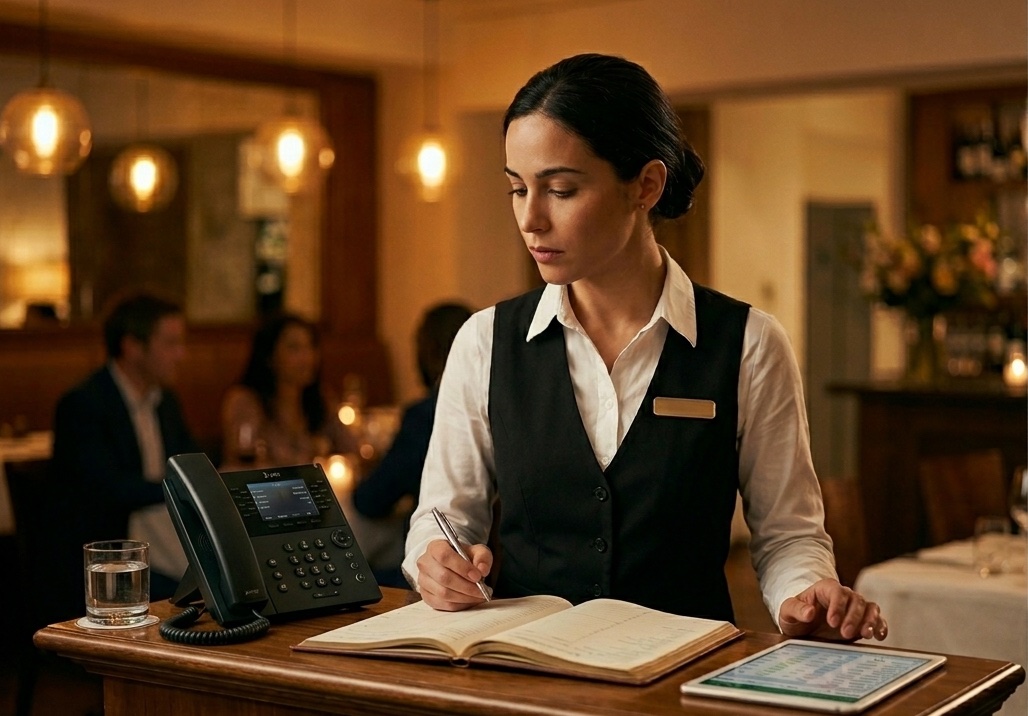
Every restaurant owner thinks of the phone as free infrastructure — a line that's just "there," costing nothing beyond the monthly bill. That's the wrong way to look at it. A restaurant phone line handled the old way — answered inconsistently, logged on paper, dependent on whichever staff member happens to be near it — isn't neutral. It's actively losing money, in ways that rarely show up on a P&L because none of them generate an obvious line item.
Every unanswered ring is a sale walking to a competitor
A restaurant phone that isn't answered within a few rings doesn't just lose that one call — it actively sends the caller to whoever answers next, which during a dinner rush is usually the restaurant down the street. There's no retry built in. Most callers don't leave a voicemail; they just dial the next option.
Staff time on the phone is staff time off the floor
A typical phone reservation — answering, checking availability, recording details, confirming, entering it into the system — takes a few minutes from start to finish. Multiply that across dozens of calls a day and it adds up to real hours of host time spent on the phone instead of greeting the guests already walking through the door.
Double-booked tables come from unsynced reservation channels
When phone bookings, walk-ins, and a paper book or spreadsheet aren't talking to each other in real time, the same table can get promised to two different parties without anyone realizing it until both show up. This is one of the most common — and most visibly embarrassing — failures in restaurant operations, and it's almost always a systems problem, not a staff problem.
Handwritten reservations have no record when something goes wrong
A notebook at the host stand works fine until a guest disputes their reservation time, a shift changes and the new host can't read the handwriting, or the book itself goes missing on a busy night. There's no backup, no search function, and no way to confirm what was actually promised on the call.
After-hours calls get nothing, even though guests are still planning
Someone deciding on tomorrow's dinner plans, or a large party trying to lock in a Saturday table, often calls in the evening — well after most restaurants have stopped staffing the phone. That call either goes to voicemail or rings out entirely, even though the guest was ready to book right then.
Order mistakes from rushed, half-heard calls cost food and trust
A staff member taking a phone order while also watching the floor is operating with divided attention by definition. Modifiers get missed, items get misheard, and the mistake isn't caught until the order's already in the kitchen — at which point it costs wasted food, a frustrated guest, or both.
A busy signal during your busiest hour turns volume into a liability
The exact moment a restaurant has the most revenue opportunity — a packed Friday dinner rush — is also the moment a single phone line is least able to keep up. High call volume should be a good problem to have. With a single line and a staff that's already stretched, it becomes the moment the most calls get missed.
No record of what callers actually wanted means no way to improve
Without any log of incoming calls, a restaurant has no visibility into how many calls it's actually getting, what people are asking about most, or when call volume actually peaks. That's valuable operational data sitting completely unused — not because anyone decided not to track it, but because a ringing phone simply doesn't generate a record.
A dedicated host for phones alone rarely pencils out for independents
Staffing a position purely to manage incoming calls and reservations is a real, ongoing labor cost — and for restaurants under roughly 60-80 seats, the call volume usually doesn't justify a dedicated full-time role. That leaves owners stuck choosing between stretching existing staff thinner or accepting missed calls as a cost of doing business.
Every missed call is invisible — it never shows up on a report
This is the reason the first nine reasons compound instead of getting noticed. A missed call doesn't trigger an alert, doesn't appear on a sales report, and doesn't generate a complaint most of the time — the caller just quietly goes elsewhere. That makes this one of the only sources of lost revenue a restaurant owner can't see without specifically looking for it.
Adding it up
None of these ten reasons is dramatic on its own. That's exactly why they're easy to ignore — each one looks like a minor inconvenience in isolation. But they compound across every shift, every week, every missed call that never makes it onto a spreadsheet.
What an unmanaged phone line is actually costing
Illustrative, not a guarantee of results for any specific restaurant — the point isn't the exact dollar figure, it's that almost none of this shows up anywhere until you go looking for it.
A phone line that loses money silently is more dangerous than one that loses money loudly — because nobody ever feels the urgency to fix it.
This is what Aria actually sounds like
Aria is the AI phone agent built by 5 to 9 Agents to close every gap above — instant answers, built-in reservations with live availability, order confirmation, and a real-time dashboard. Watch the 45-second demo, or call the live line yourself.
Why each of these features is required, not optional
Closing a single gap from the list above isn't enough — a phone solution that only answers fast but can't actually book a table, or that takes orders but never confirms them, just trades one leak for another. Every reason on this list requires every feature below to actually be fixed:
The most realistic voice, instantly
Aria sounds like a real person — natural, warm, never robotic — and answers every call instantly, closing reasons #1 and #7 in one move.
Full orders, reservations & bookings
Aria takes the complete order, confirms every item, and sends it straight to your kitchen dashboard. For tables, she checks live availability before booking — directly fixing reason #3, double-booked tables.
Real-time order dashboard
A custom dashboard ships with Aria, replacing the handwritten notebook from reason #4 — staff see every order and reservation live, tap to update status.
Confident answers to every FAQ
Menu, hours, directions, parking, dietary options, specials — answered with confidence, without pulling a staff member off the floor (reason #2).
Instant SMS confirmation
Every order and reservation gets a text the moment the call ends — closing the loop completely, with no "did that actually go through?" moment for the customer.
Customized to your restaurant
Trained on your menu, your hours, and your policies — not a generic script, and not dependent on whichever staff member happens to answer (reason #6).
Ongoing support, included
Menu changes? New hours? 5 to 9 Agents updates Aria for you — so the system that fixed reason #8 (no visibility) keeps working as your restaurant changes.
iPad + dedicated number, ready day one
Keep your existing number, no new hardware to buy — directly solving reason #9, since a dedicated host role is no longer required just to cover the phone.
Frequently asked questions
Figures referenced in this article (host labor time on phone reservations, no-show and double-booking patterns) reflect general industry reporting on restaurant operations and are provided as illustrative context, not a guarantee of results for any individual restaurant. Actual costs vary by call volume, average ticket size, and local labor rates.