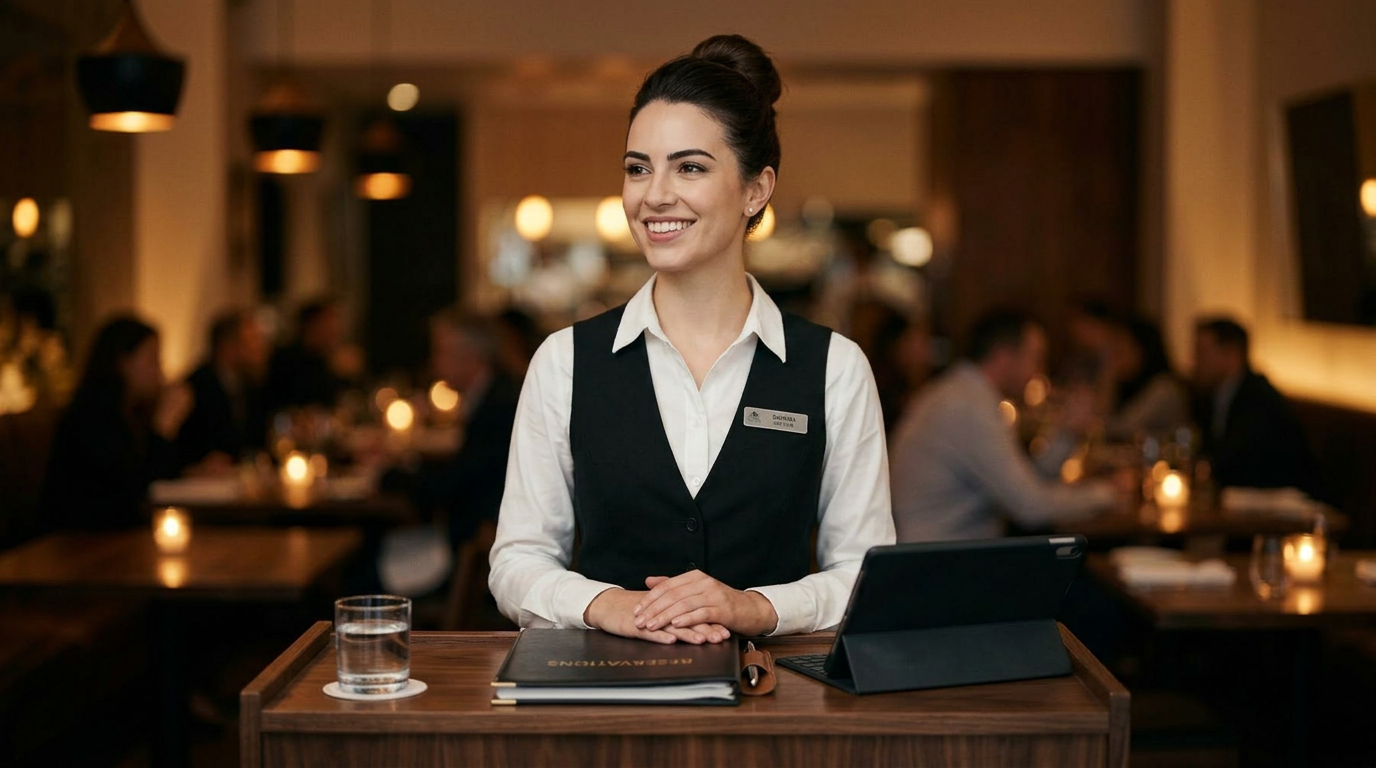
If you run an independent restaurant, you already know the feeling: it's 6:40 on a Friday, the dining room is full, two tickets just hit the kitchen, and the phone starts ringing. Nobody picks it up. By the third ring, whoever's calling has probably already opened a different restaurant's number. This isn't a staffing failure — it's a structural one, and it's worth understanding exactly why before looking at how to fix it.
Why restaurant phones go unanswered during rush
It feels like a staffing problem. It isn't, really — it's a timing collision. The hours when people are most likely to call a restaurant (to ask about a table, place a to-go order, or check if you're open) are the exact same hours your staff is busiest serving the guests already inside the building. There's no schedule that fixes that, because adding a person to answer phones just means one fewer person running food or seating tables.
Industry research backs this up. Multiple studies tracking restaurant call data have found that a large share of inbound calls — commonly cited in the 30–45% range during peak service — go unanswered, with the worst stretch typically falling in the dinner rush window. The pattern is consistent across formats: pizza and high-phone-order concepts get hit hardest, because a bigger share of their revenue depends on someone actually picking up.
Figures above are drawn from a 2025 Harris Poll survey commissioned by Hostie and a separate industry study on restaurant call volume; see the source note at the end of this article.
What a missed call actually costs you
The math is simple once you walk through it, and it's usually a bigger number than owners expect. Most restaurant phone calls aren't idle questions — research on call intent suggests roughly 60–70% of inbound restaurant calls are people trying to place an order or book a table, not just asking for hours. So a missed call isn't a missed conversation. Most of the time, it's a missed sale.
A restaurant missing even 8–10 calls a day during rush, at a modest average order value, is realistically leaving several hundred dollars a week on the table — and most of it is invisible, because a missed call doesn't show up on any report.
And the caller usually doesn't try again. Once someone hits a busy signal or voicemail, a large share never call back — they just call the next place. That's what makes this particular leak so easy to underestimate: there's no error message, no angry review, nothing that shows up in your weekly numbers. The revenue just quietly goes to whoever answered the phone instead.
The best way to handle phone orders when your restaurant is busy
There are really only three ways to handle inbound calls during a rush, and it's worth being honest about the tradeoffs of each:
- Pull a staff member off the floor to answer. Works, but it means someone stops running food, seating guests, or working the register every time the phone rings — and during your busiest hour, that's the worst possible time to lose a pair of hands.
- Let it go to voicemail. Free, but functionally the same as not answering at all — most callers placing an order won't leave a message and wait for a callback.
- Route the call to a system built to take it. Either a live answering service or an AI voice agent trained on your menu, hours, and policies that can pick up instantly, take the order, confirm it back to the caller, and send it straight to your team — without taking a person away from the floor.
For restaurants where phone orders are a real share of revenue (not just occasional calls), option three is the only one that actually scales with volume. It's also the only one that works the same way at 11 PM as it does at 7 PM on a Friday, which matters more than it sounds like it should — a meaningful chunk of calls happen outside the hours a human would even be stationed by the phone.
Can you take reservations without a dedicated hostess?
Yes — and for a lot of independent restaurants, that's the actual question underneath "how can I take reservations without a hostess." Staffing a host stand full-time, just to catch reservation calls and walk-ins, isn't realistic for a restaurant under maybe 60–80 seats. The labor cost doesn't pencil out against the volume of calls.
The alternative isn't "no reservation system" — it's a system that checks table availability, books the reservation, confirms party size, and logs it somewhere your staff can see in real time, without a person sitting by the phone all day waiting for it to ring. That's the gap AI phone agents were built to close: not replacing hospitality, but catching the calls that would otherwise just ring out while everyone's busy seating the dining room.
What is an AI phone agent for restaurants, exactly?
An AI phone agent is software that answers your restaurant's phone line and holds a real, spoken conversation with the caller — not a "press 1 for hours" menu tree. It's configured with your specific menu, hours, policies, and FAQs ahead of time, so when someone calls it can answer naturally: take a full order with modifications, check availability and book a table, or just tell someone what time you close on Sunday.
The distinction that matters most: a good AI phone agent completes the transaction on the call. It doesn't text the caller a link and hope they finish ordering online — a pattern that creates real friction for older callers or anyone who just wants to order the way they're used to ordering, by talking to someone.
This is functionally a virtual receptionist for your restaurant: always answering, always on-brand, and — unlike a human host — never pulled away to bus a table mid-call.
What to look for before choosing an AI answering service
Whether you're evaluating a specific platform or just trying to understand the category, these are the things that actually separate a system that solves the problem from one that just sounds good in a sales call:
The buyer's checklist
One more thing worth being clear-eyed about: not every approach in this category is built the same way. Some answering tools mainly screen calls and forward callers elsewhere; some are built specifically for order-taking and skip reservations; some require deep point-of-sale integration work before they're useful at all. None of that makes a tool "bad" — it just means the right fit depends on whether your restaurant's calls are mostly orders, mostly reservations, or a mix of both, and how much setup complexity you're willing to take on.
How Aria handles this for restaurants
Aria is the AI phone agent built by 5 to 9 Agents specifically for independent restaurants — designed around the checklist above, not around what's easiest to build. The features below aren't add-ons. For a restaurant phone line to actually fix the problems covered in this guide, every one of them is required, not optional:
A real voice, not a robot
Aria has the most realistic voice available — natural, warm, and respectful in every conversation. Callers talk to her the way they'd talk to a person, and she answers every call instantly, every time.
Full orders, reservations & bookings
Aria takes the complete order, confirms every item, and sends it straight to your kitchen dashboard. For reservations, she checks availability, books the table, confirms party size, and logs it in real time.
Real-time order dashboard
A custom, integrated dashboard comes with Aria. Your staff sees every order and reservation live, and taps to move status from New → In Kitchen → Ready → Completed.
Confident answers to every FAQ
Menu, hours, directions, parking, dietary options, specials — Aria knows your restaurant and answers with confidence, because she's trained specifically on it.
Instant SMS confirmation
Every order and reservation gets a text confirmation the moment the call ends — so the customer knows it's locked in, with no "did that actually go through?" moment.
Trained on your restaurant specifically
Not a generic script — Aria is customized to your menu, your hours, and your policies, and answers every call your team simply can't get to.
Ongoing support, included
Menu changes, new hours, seasonal specials — 5 to 9 Agents updates Aria for you. You're never left to figure out a backend on your own.
iPad + dedicated number, ready day one
Your current phone number stays the same — calls forward to a dedicated line, no new hardware to buy. A fully configured iPad ships ready to use from day one.
Hear Aria answer a real restaurant call
The fastest way to understand what this actually sounds like is to watch the 45-second demo, or call the live demo line yourself and try placing an order or booking a table.
Frequently asked questions
Sources: missed-call and caller-behavior figures referenced above are drawn from a May–June 2025 Harris Poll survey of U.S. adults commissioned by Hostie, and from industry reporting on restaurant call-volume patterns (Breez, 2025; QSR Magazine). Figures are cited as industry-reported ranges, not independently verified by 5 to 9 Agents, and are provided for general context rather than as a guarantee of results for any specific restaurant.