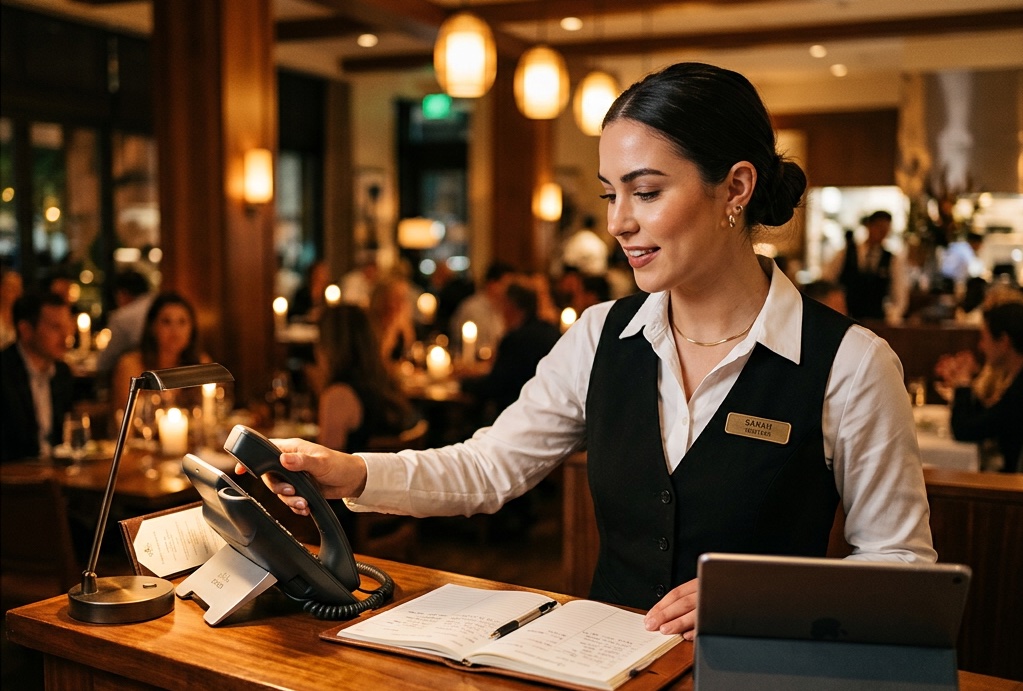
Here's a question most restaurant owners have never actually asked: when a customer calls and nobody picks up, how long do they wait before they hang up? Not metaphorically — literally, in seconds. The answer matters more than it sounds like it should, because that handful of seconds is where a huge share of restaurant phone revenue quietly disappears, with no error message, no bad review, nothing that shows up on a single report.
The countdown nobody's watching
Every unanswered call runs on an invisible clock. The caller doesn't consciously count rings — but their patience is doing the math anyway, based on something deeper: a lifetime of learning what an unanswered phone means. We've come to call this the 7-second rule — not a single scientific figure, but a useful way to describe the real pattern behind it: across phone etiquette research and call-handling standards, the window before callers start assuming nobody's coming consistently lands around three to four rings, roughly 12 to 20 seconds. Past that point, the caller isn't really listening for an answer anymore. They're deciding where to call next.
That's the part most restaurants miss. The call doesn't fail when the caller hangs up — it fails earlier, somewhere around ring three, when the silence on the other end starts to read less like "the restaurant is busy" and more like "nobody's going to answer this." By the time the call actually ends, the decision was already made.
Why customers hang up (it's not impatience)
It's tempting to write this off as modern impatience — everyone wants everything instantly these days. But that framing gets the psychology backwards. Callers aren't hanging up because they're entitled. They're hanging up because a ringing phone is a signal, and they've learned to read it accurately.
An unanswered phone doesn't mean "wait." To most callers, it means "try somewhere else" — and they act on that belief faster than most restaurant owners would guess.
Think about what a caller actually knows in that moment: they don't know if you're closed, slammed, short-staffed, or simply didn't hear the phone over the kitchen noise. All they have is silence and a ring count. In the absence of information, people default to the least generous interpretation — not out of malice, but because it's the safer assumption when they're hungry and deciding where dinner is coming from.
The four real reasons callers give up
Pull apart what's actually happening on the caller's end, and it usually comes down to one of these:
They assume you're too busy to help
A long ring reads as "swamped, can't take this call right now" — and a swamped restaurant doesn't sound appealing to someone trying to order dinner in the next ten minutes.
They assume you might be closed
Hours posted online aren't always trusted at face value. An unanswered phone is, fairly or not, read as a sign the restaurant might not actually be open right now.
They have somewhere else to be
Most calls happen in a narrow decision window — on a work break, between errands, mid-commute. There usually isn't slack in their schedule to wait it out.
The alternative is one tap away
Unlike twenty years ago, hanging up doesn't mean giving up on dinner — it means searching the next restaurant in about four seconds. The cost of trying somewhere else has basically dropped to zero.
None of these reasons are about the caller being unreasonable. They're about a restaurant's silence being interpreted the only way silence can be interpreted: as an answer.
Why "they'll just leave a voicemail" doesn't hold up
This is the assumption that quietly costs restaurants the most. It feels safe — "if I miss it, they'll leave a message and I'll call back." In practice, this almost never plays out the way it sounds. A caller trying to book a table or place an order wants an answer now, not a promise of a callback at some unknown point later. Voicemail doesn't feel like a solution to them — it feels like more waiting, with worse odds.
And even when a callback does happen, the moment that mattered has usually already passed. Someone deciding what to order for dinner at 6:45 PM has, by 7:10 PM when your team finally calls back, often already ordered from somewhere else. The window where that customer was genuinely choosing your restaurant was narrow, and it closed the second they hung up.
- Caller hits voicemail, doesn't leave a message
- Caller searches the next restaurant immediately
- Order or reservation goes to a competitor
- Restaurant never even sees the missed call as lost revenue
- Call is answered before doubt has time to set in
- Order or reservation is taken on the spot
- Caller never has a reason to consider another restaurant
- The call shows up as revenue, not as a number nobody tracked
What changes when something answers on ring one
The fix here isn't really about being faster than a competitor — it's about getting ahead of the moment where doubt starts to form in the caller's mind. If a call is answered before that three-to-four-ring threshold, the entire psychology of the interaction is different. The caller never has to interpret silence, because there isn't any.
This is, functionally, the entire argument for routing restaurant calls through a system that answers instantly rather than one that depends on a staff member being free. It's not about replacing hospitality — it's about making sure hospitality gets a chance to happen at all, instead of losing the caller before anyone on staff even knew the phone rang.
Phone rings
Caller is hopeful, expecting a normal answer.
Second ring passes
Still neutral, but attention starts splitting toward "what if no one picks up."
Doubt sets in
Caller begins mentally drafting a backup plan — usually a second restaurant.
Decision made
Caller hangs up. The next call they make is to someone else, not back to you.
What it sounds like when nobody waits
The fastest way to understand the impact of answering on the first ring is to hear it. Watch the 45-second demo, or call the live line yourself and time how fast it picks up.
How Aria removes the countdown entirely
Aria, the AI phone agent built by 5 to 9 Agents, exists specifically to eliminate this window. Every feature below plays a role in making sure a caller never has the chance to start counting rings:
The most realistic voice, instantly
Aria sounds like a real person — natural, warm, never robotic — and answers every call instantly, before doubt ever has a chance to set in.
Full orders, reservations & bookings
Aria takes the complete order, confirms every item, and sends it straight to the kitchen dashboard. For tables, she checks availability and books on the spot — so the caller never has a reason to hang up and dial elsewhere.
Real-time order dashboard
A custom dashboard ships with Aria. Staff see every order and reservation the moment it comes in, and move it from New → In Kitchen → Ready → Completed with a tap.
Confident answers, no hold required
Menu, hours, directions, parking, dietary questions — Aria knows your restaurant and answers immediately, with no "let me check" pause that gives doubt a foothold.
Instant SMS confirmation
Every order and reservation gets a text the second the call ends, closing the loop completely — no lingering "did that actually go through?" moment after they hang up.
Customized to your restaurant
Trained on your specific menu, hours, and policies — Aria answers every call your team simply can't get to in time.
Ongoing support, included
Menu changes, new hours, seasonal specials — 5 to 9 Agents updates Aria for you, so the instant answer stays accurate as your restaurant changes.
iPad + dedicated number, ready day one
Keep your existing number — calls just forward to a dedicated line. A fully configured iPad arrives ready to use, so there's no delay before every call gets answered.
The goal isn't to answer the phone faster than a human could in theory. It's to make sure every single call gets answered before the caller's internal countdown ever has a chance to run out.
Frequently asked questions
The "7-second rule" is 5 to 9 Agents' own framing of a consistent pattern found across phone etiquette and call-handling standards — most point to a three-to-four-ring (roughly 12–20 second) window before caller patience drops sharply — rather than a single externally published statistic. It's intended as a useful way to think about caller behavior, not a precise measurement for any individual restaurant.